


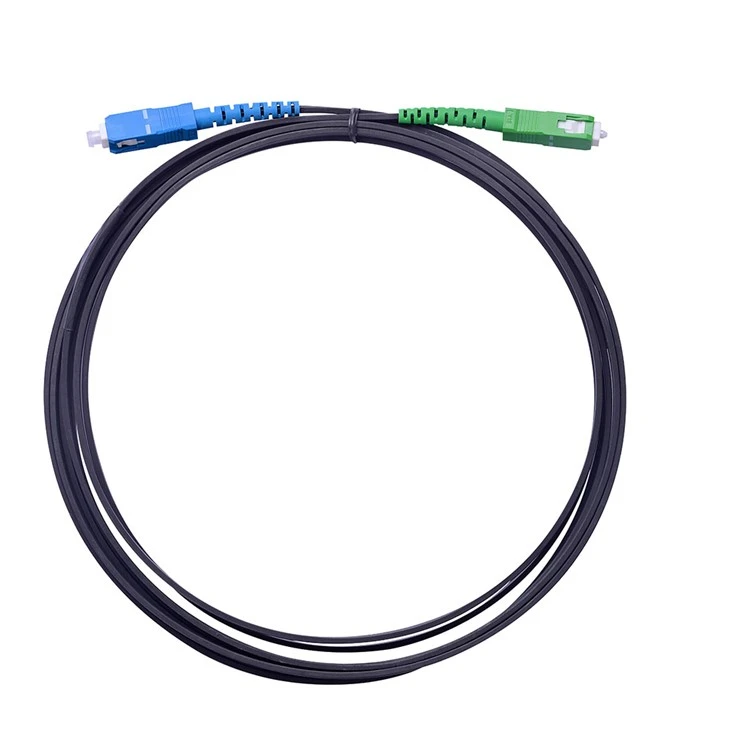
Sc Apc To Sc Upc Patch Cable

50 patch cord (1)(001)
50 patch cord (2)
Sc Apc To Sc Upc Patch Cable
Drop cables are cables that run from the distribution point or cable to the subscriber/user.
Fiber patch cord, often called fiber patch cable, fiber jumper, or fiber patch lead, is a length of fiber cable that terminated with fiber optic connectors at each end. The connectors allow fiber optic patch cord to be rapidly connected to an optical switch or other telecommunications/computer device.
Description
Technical Parameters
our company
Environmental Characteristics
- Transport/storage temperature: -20℃ to +60℃
Delivery Length
- Standard reel length:5m,10m,20m,35m, 45m,50m,75m,100m,150m,200m,300m;
- Other lengths are also available.
Our services
1. 24-hour one-on-one online service to ensure efficient support.
2. Thoughtful customer reception from hotel reservation to factory visit.
3. Extremely cautious throughout the process from order confirmation to product shipment.
own brand




Pack and ship


Tips
Comparison of Fiber Optic Cold Splicing and Fusion Splicing Technologies
1. Fusion Splicing Technology
Fusion splicing refers to the technology that uses an arc discharge generated by a fiber optic fusion splicer to heat the end faces of two optical fibers to a molten state and then fuse them together. After splicing, a heat shrink sleeve is required for protection to restore the mechanical strength of the fiber. This is a permanent connection method and is currently the preferred solution for backbone networks and core networks.
2. Cold Splicing Technology
Cold splicing is a physical connection method that does not rely on heating and melting. Instead, it aligns the end faces of two optical fibers using a precision V-groove structure, combined with a matching liquid (refractive index matching gel) to achieve optical signal transmission. Cold splice connectors or fiber quick connectors are the main implementations of cold splicing technology. The entire splicing process can be completed within a few minutes without the need for a fusion splicer.
Advantages and Disadvantages Analysis
1. Advantages of Fusion Splicing
**(1) Optimal Connection Quality**
Fusion splicing achieves a truly permanent connection by fusing the fiber end faces together. Its typical splice loss is 0.01~0.05dB, which is far lower than that of cold splicing technology. This is crucial for long-distance transmission, as the accumulated loss from multiple splices can significantly impact the link budget.
**(2) High Long-Term Stability**
The splice point is sealed and protected by a heat shrink sleeve, resisting erosion from environmental factors such as dust and moisture. The lifespan of a fusion splice is essentially equivalent to that of ordinary optical cables, requiring no maintenance or replacement for many years.
**(3) Extremely Low Material Cost per Splice**
Each fusion splice requires only one heat shrink sleeve, costing approximately 0.1~0.5 RMB. This cost advantage is very significant in projects involving a large number of splice points.
2. Disadvantages of Fusion Splicing
**(1) High Equipment Cost**
The price of a fiber optic fusion splicer is typically tens of thousands of RMB, requiring a high initial investment for construction teams. Additionally, fusion splicers require regular maintenance, with electrodes needing replacement approximately every 2,000 splices.
**(2) Requires Power Supply**
Fusion splicers rely on battery power. Although the battery life of modern fusion splicers has greatly improved, recharging still needs to be considered during large-scale field operations or construction in remote areas.
**(3) High Operational Skill Requirement**
Fusion splicing requires professionally trained operators, with high demands placed on cleaving, cleaning, and arc parameter settings.
3. Advantages of Cold Splicing
**(1) Low Equipment Investment**
Cold splicing only requires basic tools such as a fiber cleaver and strippers, without the need for an expensive fusion splicer. This lowers the cost barrier for startup construction teams or temporary jobs.
**(2) Fast and Convenient Operation**
The installation of cold splice connectors is very fast. A skilled operator can complete a single splice in about 30 seconds. This efficiency advantage is particularly prominent in emergency repairs or temporary cabling scenarios.
**(3) No Power Required**
Cold splicing is a completely mechanical operation that does not rely on a power supply, making it suitable for work in the field or in environments without electricity.
4. Disadvantages of Cold Splicing
**(1) Higher Connection Loss**
Typical cold splice loss is 0.1~0.3dB, and in some cases can even reach 0.5dB. This is approximately 5 to 10 times higher than fusion splicing loss, and the accumulation of multiple cold splices can seriously affect link quality.
**(2) Limited Service Life**
Cold splicing technology relies on matching liquid (refractive index matching gel) to achieve effective optical signal transmission. The lifespan of domestically produced matching liquid is about 1.5 to 2 years, while imported matching liquid lasts about 3 years. After the matching liquid ages, leaks, or becomes contaminated, the splice loss will increase sharply, requiring rework.
**(3) High Material Cost per Splice**
The cost of a cold splice connector or fiber quick connector is approximately 15~50 RMB, which is tens or even hundreds of times higher than the material cost of fusion splicing. This cost difference cannot be ignored in FTTH projects with a large number of splice points.
**(4) Questionable Long-Term Reliability**
The mechanical clamping structure of a cold splice point may loosen after long-term use, and the aging problem of the matching liquid persists. Furthermore, cold splicing requires extremely high on-site cleanliness, as any dust contamination will cause a significant increase in loss.
Hot Tags: sc apc to sc upc patch cable, China sc apc to sc upc patch cable manufacturers, suppliers, factory, Aerial Drop Cable, Fiber Optic Cable Ftth, Flat Drop Fiber Cable, ftth drop cable and patch cords, Outdoor Drop Cable, Sc Apc To Sc Upc Patch Cable
Technical Characteristics
| Cable Part | |
| Fiber Count | 1~4 |
| Fiber type | G657A1 or A2 |
| Strength Member Material | FRP or Steel wire |
| Dielectric Strength Member size | 2 x 0.5mm /2x0.4mm |
| Messenger Material | Steel wire |
| Messenger size | 1.0mm / 7*0.33mm |
| Nominal Outer Dimensions(±0.3) | 2.0 mm x 5.0 mm |
| Outer Jacket Material | LSZH |
| Tension Strength (Short-Term / Long-Term) | 300N/600N |
| Crush Resistance (Short-Term / Long-Term) |
1000 N/100mm 2200 N/100mm |
| Minimum Bend Radius (Static / Dynamic) | 20 x OD / 40 x OD |
| Connectors part | |
| Connector type | SC/UPC,SC/APC |
| Insertion Loss | ≤ 0.25dB |
| Return Loss (For Single mode) | UPC ≥ 50dB , APC ≥ 60dB |
| Repeatability | ±0.1dB |
*All above the cable size can be customized.
Previous
Outdoor Drop CableNext
No InformationSend Inquiry


