
Aramid Fiber Cable
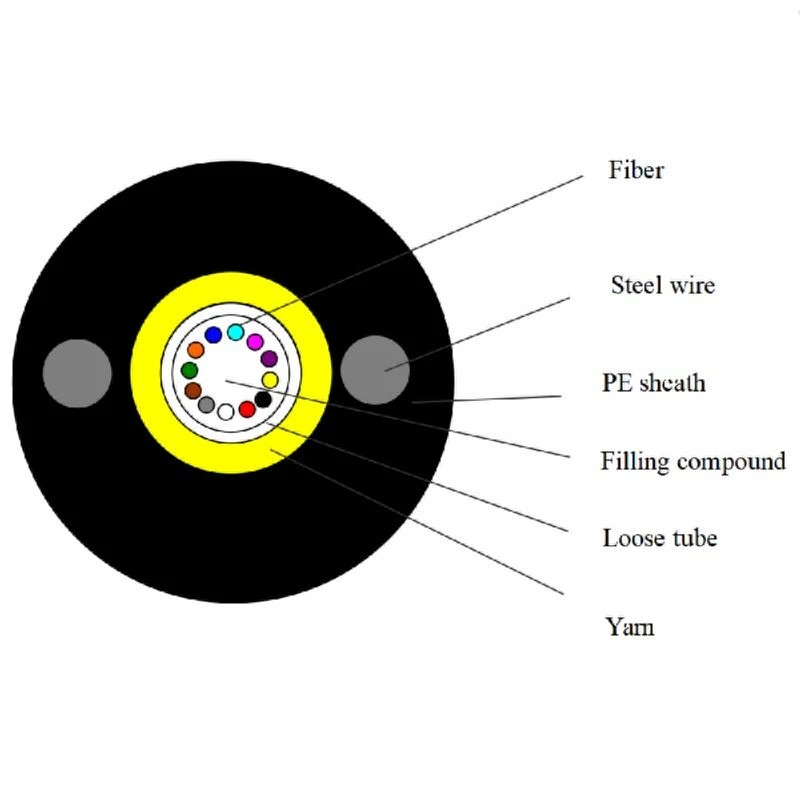
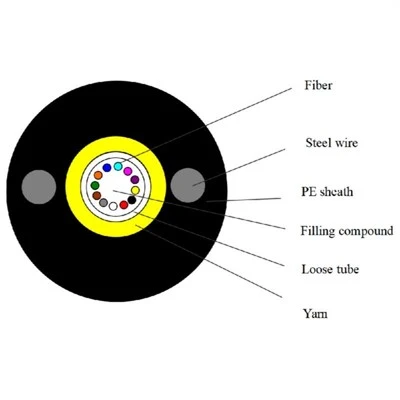
GYXY with yarn kabel duct fiber optic cable, optical fibers are housed in a loose tube that is made of high-modulus plastic(PBT)and filled with special ointment. The tube is armored with a layer of polyester yarn or aramid yarn and two parallel steel wire, then a PE sheath is extruded.
Description
Technical Parameters
our company

Features
*Two parallel steel wires ensure tensile strength.
*Embedded strength member provide desirable tensile strength.
*Compact, easy to install.
*UV and moisture-resistant design
*All above the cable size can be customized.
Environmental Characteristics
• Transport/storage temperature: -40℃ to +60℃
Delivery Length
• Standard reel length: 2km/drum or 3km/drum; other lengths are also available.
Post-sale quality issues
If there are any quality problems, you can take photos for our reference. Our QC department will inspect the issue and provide you with the best solution, which could be repair, refund or return.
own brand


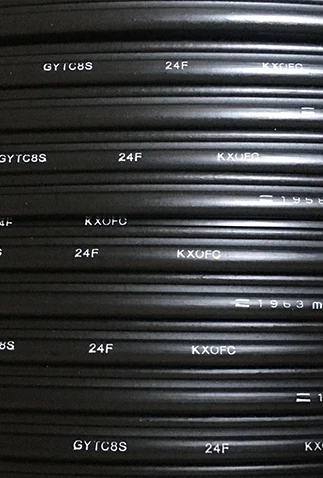


Pack and ship


Tips
Development Status and Challenges of New Types of Optical Fibers
Ultra-Low-Loss Optical Fibers Have Entered Large-Scale Commercial Application; China Should Accelerate Their Deployment
Ultra-low-loss optical fiber technology has gradually matured, facilitating the evolution of optical transmission systems toward ultra-high speed, large capacity and long-distance transmission.
In China's backbone network, G.652.D optical fibers dominate with a market share exceeding 95%. They support 400 Gbit/s per wavelength and higher transmission rates, as well as transmission across the C+L bands and beyond, delivering excellent performance in ultra-long-haul and large-capacity transmission, while continuously being optimized for lower loss. Meanwhile, G.654.E ultra-low-loss optical fiber manufacturing technology has become mature. Its large effective-area core reduces nonlinear effects significantly and greatly cuts transmission loss.
Globally renowned manufacturers including China's YOFC, Hengtong Optic-Electric, FiberHome, Zhongtian Technology, as well as Corning (USA) and Sumitomo (Japan), have launched commercial ultra-low-loss fiber products. China's three major telecom operators have launched large-scale procurement and deployment. The total length of newly deployed G.654.E ultra-low-loss optical cables (including hybrid G.652.D and G.654.E cables) exceeded 35,000 route-kilometers in 2023, with further expansion continuing in 2024. These cables have also been adopted in private networks for power grids, railways and other industries.
In the coming years, as legacy cables in China's "Eight Vertical and Eight Horizontal" backbone network reach end-of-life, large-scale deployment of G.654.E and other ultra-low-loss fibers will be accelerated across national backbone networks, inter-provincial trunk lines and provincial backbone networks. This will support ultra-large-capacity optical transmission systems at 400 Gbit/s, 800 Gbit/s and beyond, underpinning the development of new productive forces in information communications and the high-quality growth of national computing networks.
Space-Division Multiplexing Optical Fibers: Application Trials Underway for Both Terrestrial and Submarine Cables
Constrained by the inherent physical limits of conventional single-mode fibers, the total transmission capacity of a single-mode fiber is capped at roughly 100 Tbit/s. To break this capacity bottleneck, global research institutions are focusing on next-generation optical communication technologies based on space-division multiplexing (SDM) fibers.
China's R&D level for SDM fibers and related systems is generally on par with the international frontier. However, key technologies and supporting components are not yet fully mature, preventing immediate mass commercialization. Further R&D investment from industry, academia and end users is required to achieve critical breakthroughs.
International Progress
In 2024, Google collaborated with Japan's NEC to deploy a multi-core fiber-based TPU submarine cable system, scheduled for completion and commissioning by late 2025. Also in 2024, at the European Conference on Optical Communication (ECOC), Japan's NICT (National Institute of Information and Communications Technology) demonstrated a 38-core 3-mode fiber system achieving a total capacity of 22.9 Pbit/s. Separately, Japan's NTT and NEC completed a 7,280 km transoceanic transmission trial using 12-core optical fibers in 2024.
Domestic Progress
In 2023, China Information and Communication Technologies Group built a 19-core single-mode multi-core fiber transmission system with a total capacity of 4.1 Pbit/s. In 2024, YOFC and China Mobile successfully piloted multi-core fiber solutions for data center interconnections, while Hengtong Optic-Electric researched 38-core shared-fiber transmission for distributed sensing and high-capacity communications.
Overall, multi-core SDM fibers will first undergo field trials in submarine cable systems and data center interconnections, paving the way for formal commercial adoption.
Hollow-Core Optical Fibers: A Disruptive Enabling Technology for the Optical Communications Industry
Hollow-core optical fibers outperform conventional solid-core fibers in key metrics: transmission capacity, bandwidth, latency, nonlinear effects and dispersion. They are expected to drive disruptive innovations across optical cables, optoelectronic devices and transmission systems, enabling brand-new application scenarios. China must seize this critical innovation window to accelerate R&D and establish global leadership in hollow-core fiber technology.
Among hollow-core fiber structures, anti-resonant hollow-core fibers show outstanding performance, first proposed by researchers at the University of Bath in 2002. Institutions including the University of Bath, the University of Southampton and Microsoft have taken an early lead in hollow-core fiber R&D and industrialization. They have achieved a transmission loss below 0.11 dB/km in the 1550 nm band, breaking the traditional 0.14 dB/km loss limit of solid-core fibers.
Chinese universities, research institutes, fiber manufacturers and operators have conducted years of research on hollow-core fibers. China's overall R&D level matches global progress, with diverse field trials underway. Nevertheless, manufacturing processes, system integration and overall technical maturity remain insufficient, with multiple technical challenges requiring further verification and breakthroughs.
The hollow-core fiber sector is now in a crucial development phase with fierce global competition. To unlock its disruptive potential, China needs to strengthen cross-industry collaboration, increase R&D and industrial investment, and improve the maturity of hollow-core fiber fabrication, optical transceivers and transmission systems. This will help build lasting technological advantages and sustain China's global leadership in the optical communications industry.
Hot Tags: aramid fiber cable, China aramid fiber cable manufacturers, suppliers, factory
Technical Characteristics
|
Fiber Count |
2~24 |
|
Loose Diameters |
2.0~2.8mm |
|
Loose Material |
PBT (Polybutylene Terephthalate) |
|
Strength Member Material |
Steel wire & Yarn |
|
Strength Member size |
1.0mm Two steel wires |
|
Outer Jacket Material |
PE |
|
Nominal Outer Dimensions |
6.0~8.0 mm (±0.3) |
|
Tension Strength (Long-Term /Short-Term) |
600N/1000N |
|
Crush Resistance (Long-Term /Short-Term) |
300 N/100mm 1000 N/100mm |
|
Minimum Bend Radius (Static / Dynamic) |
10 x OD / 20 x OD |
*All above the cable size can be customized.
Previous
No InformationNext
Light Fiber CableSend Inquiry


