

Aramid Cable
Description
Technical Parameters
our company
Features
- PBT has good hydrolysis resistance and high strength.
- Two parallel FRP and yarns ensure the tensile strength of the cable.
- PE sheath has excellent anti-UV .
- Small diameter, light weight, easy to lay.
- Excellent mechanical properties and temperature characteristics.
*All above the cable size can be customized.
Environmental Characteristics
• Transport/storage temperature: -40℃ to +60℃
Delivery Length
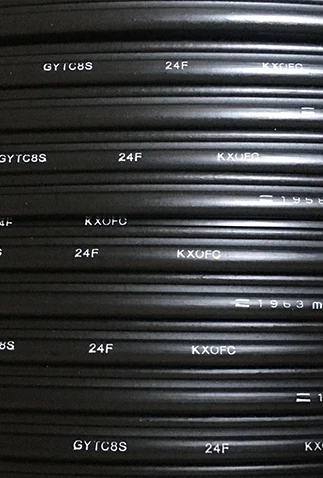
• Standard reel length: 2km/drum or 3km/drum; other lengths are also available.
Our services
1. 24-hour one-on-one online service to ensure efficient support.
2. Thoughtful customer reception from hotel reservation to factory visit.
3. Extremely cautious throughout the process from order confirmation to product shipment.
own brand




Pack and ship


Tips
Progress of International and Domestic Standardization for New Types of Optical Fibers
A systematic framework for international optical fiber and cable standards has been established, and China's standardization work is generally aligned with global progress. International optical fiber and cable standards are mainly developed by Working Group 5 of Study Group 15 (SG15) of the International Telecommunication Union Telecommunication Standardization Sector (ITU-T), as well as the IEC SC 86 working group of the International Electrotechnical Commission (IEC), forming a relatively complete standard system. The latest research cycle focuses on space-division multiplexing optical fibers and hybrid optical-electrical cables, with active participation from organizations across the EU, the United States, Japan and China.
Domestically, the WG1, WG3 and WG4 working groups of the Transmission and Access Network Technical Committee (CCSA TC6) under the China Communications Standards Association (CCSA) have released a series of industry standards for optical fibers, cables, components and transmission systems. Multiple research projects concerning new fibers such as space-division multiplexing fibers and hollow-core fibers have been formally initiated. Further standardization projects for these new fibers will be launched and carried out gradually.
To advance the international standardization of new optical fibers, China needs to strengthen cross-industry collaboration and coordinated efforts in the following areas:
In the field of ultra-low-loss optical fibers, ITU-T G.652 and G.654 standards have been in place for many years. For long-haul transmission scenarios supporting 800 Gbit/s per wavelength and above, there is demand for wider usable spectrum beyond the C6T+L6T bands and lower cut-off wavelengths. It is essential to conduct further research on key parameters of new ultra-low-loss large-effective-area single-mode fibers and formulate unified global standards accordingly.
For space-division multiplexing optical fibers, ITU-T SG15 approved the G.sup.G.65x project in December 2023, launching formal standardization work. This project aims to define fiber types, target application scenarios, technical frameworks and development roadmaps for space-division multiplexing fibers. Priority is also given to multi-core and few-mode fiber standards for submarine cable systems, especially specifications for 2-core and 4-core single-mode fibers. China should seize this opportunity to participate deeply and contribute to global standard-setting.
Regarding hollow-core optical fibers, formal ITU-T international standardization work has not yet officially started, though relevant proposals are already under discussion. Domestically, CCSA TC6 has launched research projects covering hollow-core fibers, supporting optoelectronic devices and transmission systems. After unifying domestic technical specifications, China will promote corresponding international standardization collaboratively. Hollow-core fibers are expected to become a major focus of global optical fiber standardization in the future.
Hot Tags: aramid cable, China aramid cable manufacturers, suppliers, factory
Technical Characteristics
|
Fiber Count |
2~24 |
|
Loose Diameters |
2.0~2.5mm |
|
Loose Material |
PBT (Polybutylene Terephthalate) |
|
Dielectric Strength Member Material |
FRP & Yarn |
|
Dielectric Strength Member size |
1.0mm (FRP) |
|
Outer Jacket Material |
PE |
|
Nominal Outer Dimensions |
6.0~8.0 mm (±0.3) |
|
Tension Strength (Long-Term /Short-Term) |
600N /1000N /600N |
|
Crush Resistance (Long-Term /Short-Term) |
300 N/100mm 1000 N/100mm |
|
Minimum Bend Radius (Static / Dynamic) |
10 x OD / 20 x OD |
*All above the cable size can be customized.
Previous
Flat Fiber CableNext
FRP Fiber CableSend Inquiry


