

Why are MPO cables selling so well?
Jul 20, 2026
Leave a message
I. Structure of MPO: Four layers from outside to inside
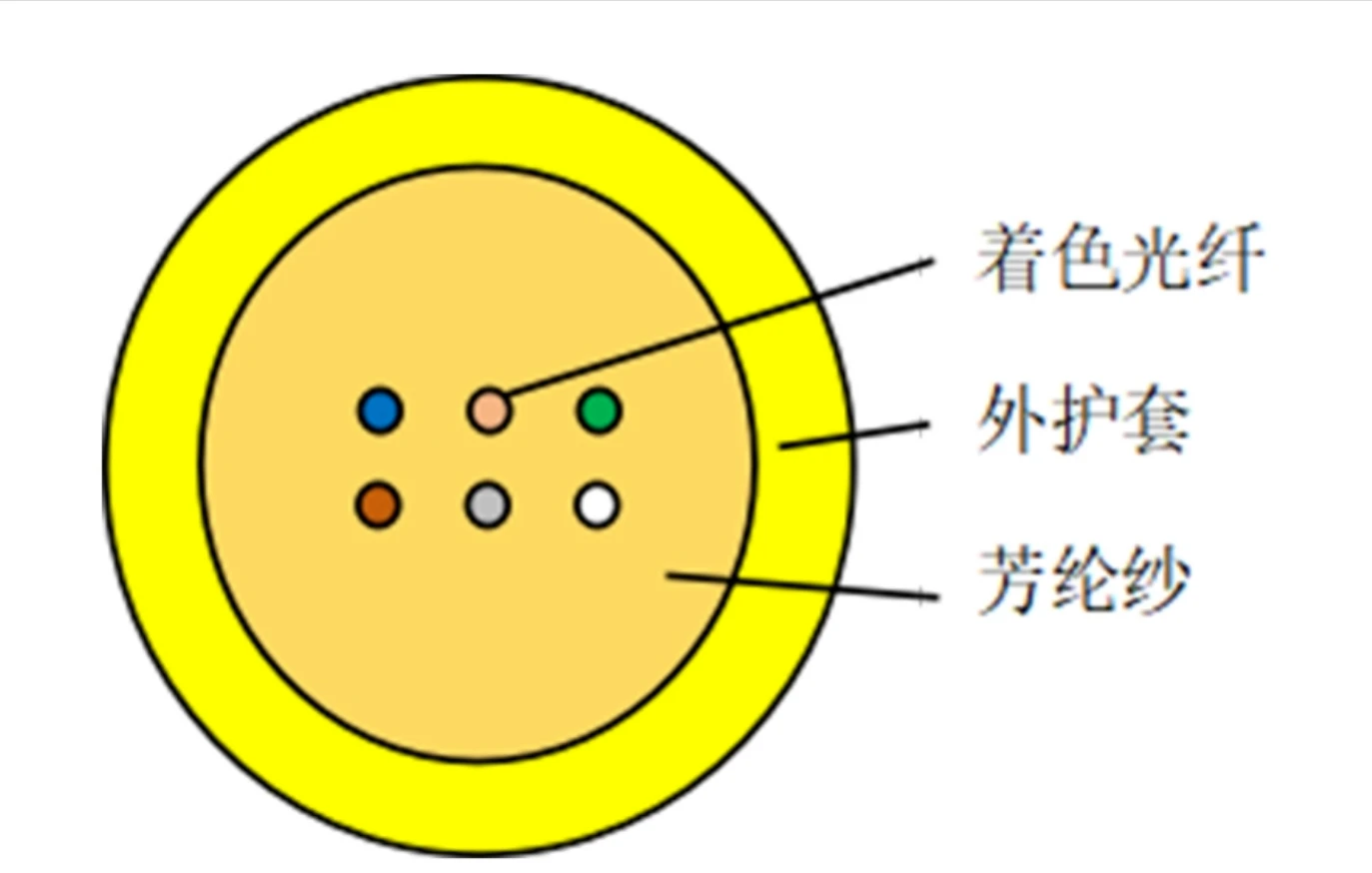
When an MPO cable is disassembled, it consists of four layers.
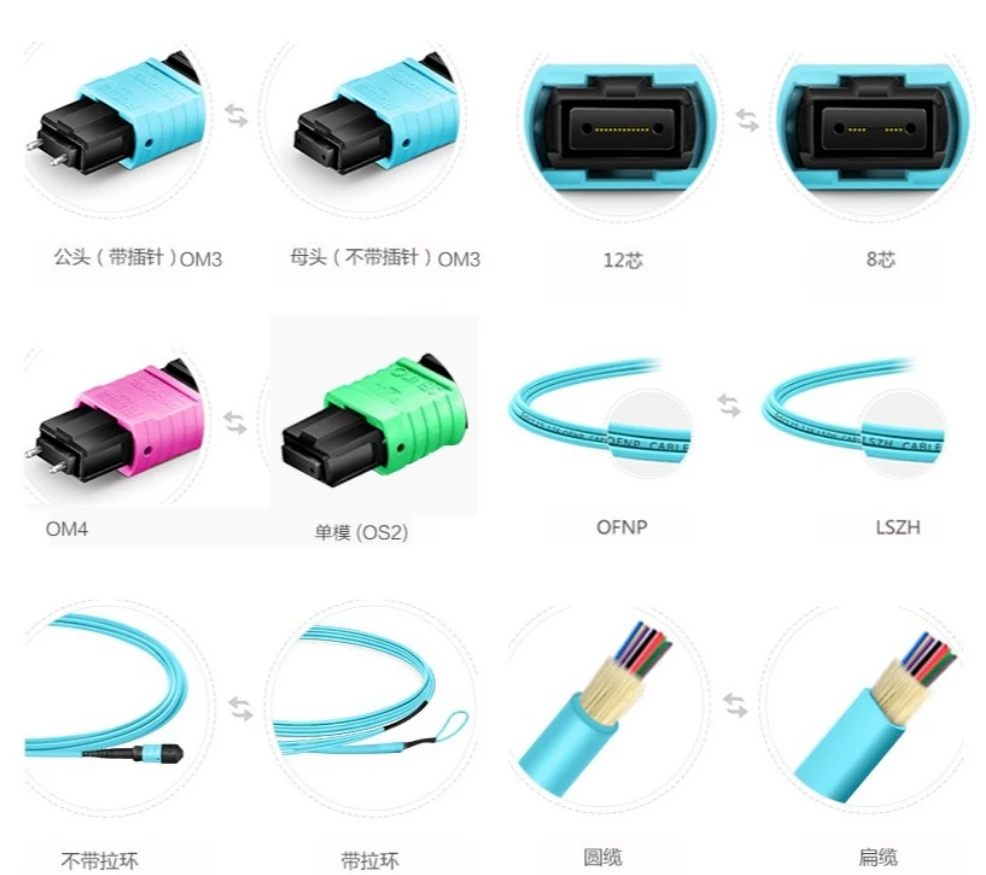
The innermost layer is the optical fiber. For short-distance interconnection in data centers, multi-mode optical fibers (OM3/OM4/OM5) are mainly used, while single-mode OS2 is used for cross-building or long-distance scenarios. Usually, one MPO cable can accommodate 12 cores, 16 cores, or 24 cores. In high-density wiring scenarios, it can even reach 48 cores or 144 cores.
The second layer is the aramid fiber reinforcement. It is the same as the Kevlar material we mentioned before, with an tensile strength of over 120N, protecting the fragile optical fibers from being pulled apart. Without aramid, the MPO cable would be just a brittle glass fiber.
The third layer is the sheath. Standard cables use LSZH (low smoke, low halogen) materials, which are flame-retardant, wear-resistant, and moisture-proof. The armored version wraps an additional layer of corrugated steel pipe or aluminum armor outside the aramid, providing a tensile strength from 200N to over 1000N, suitable for harsh environments.
The most crucial fourth layer is the MT connector core.
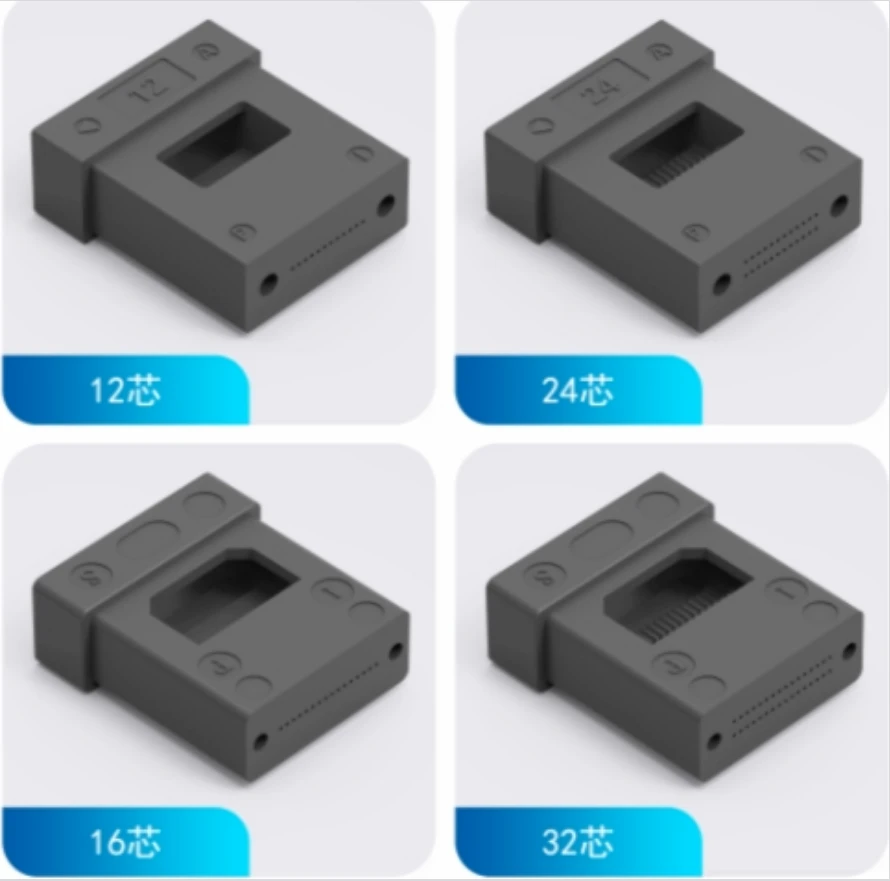
The MT connector core is the soul of the entire MPO. It is a 6.4mm × 2.5mm rectangular small square, with precisely arranged 8 to 72 micro-hole channels inside, with a channel spacing of 0.25mm. When two connectors are aligned, dozens of optical fibers need to be aligned simultaneously at the sub-micron level - any deviation of 0.5 micrometers will cause the optical signal to attenuate.
MPO connectors are divided into male and female types. The male connector has two stainless steel pins (PIN pins), while the female connector has a through-hole. When they are aligned, the pins are inserted into the holes, locking the positions of the two connectors. One male and one female are necessary. Male-to-male will break the pins, and female-to-female will not align the optical fibers properly.
II. MT Core: The Hardest Bone in the MPO Supply Chain
Why is MPO so expensive? The key lies in the MT core.
This small square, about the size of a palm, has to meet several extreme requirements:
First, the precision of the micropore array. When 12 optical fibers are placed side by side, the pore spacing is 0.25mm, and the diameter deviation of each pore must not exceed ±0.5μm. For 48-core and 72-core systems, the requirements are even more extreme - the entire core is densely covered with dozens or hundreds of micropores, and any deviation in the position of a single pore will result in that fiber being unusable.
Second, the geometric parameters of the end face. For 800G and 1.6T systems, the insertion loss requirement has been reduced from the traditional 0.35dB to below 0.15dB, and the return loss must be stable at -60dB or even lower. This means that the curvature radius of the fiber end face must be controlled within an extremely narrow range of 10-15mm, and the vertex offset must not exceed 0.5 micrometers.
Third, consistency. It's not enough to just make one good one; it's necessary to ensure that hundreds of thousands of cores can be produced with the same quality.
The materials for the core come in two camps. One camp uses ceramic substrates, which are formed by sintering alumina or zirconium oxide. They have high precision and good stability, but the processing is difficult and the cost is high. Tianfu Communication is the core supplier of ceramic cores globally and supplies half of the MPO manufacturers worldwide. The other camp uses polymer injection molding, which is formed by injecting modified PPS material. They have low costs and fast production, but the material formula and mold precision are monopolized by overseas companies.
Regardless of which camp, the core bottleneck lies in the molds. The special ultra-precision injection molds for 48/72-core ultra-high-core MPO cores are currently only available from a few enterprises in the US and Japan. The mold delivery cycle is 12-18 months. Domestic manufacturers still have a gap in processing accuracy and stability, and the yield of high-end cores has long been lower than that of Japanese companies.
III. How to make the core? Five steps from raw material to finished product
The manufacturing of MT core is essentially a precision processing production line.
The first step is shaping. For the ceramic route, it follows powder metallurgy - the alumina/zirconia powder is pressed into a green body, then sintered at high temperature (1400-1600℃), and the sintered ceramic piece has extremely high hardness. Then, it undergoes precise processing. For the polymer route, it follows injection molding - modified PPS particles are injected into an ultra-precise mold under high temperature and high pressure, and then cooled to form. The injection molding efficiency is much higher than that of ceramics, but the cost and precision of the mold are the key factors.
The second step is micro-hole processing. Micro-holes with a spacing of 0.25mm are drilled on the shaped core. For ceramic pieces, laser processing or mechanical drilling is used, while for injection molded pieces, the accuracy of the mold itself is relied upon - the protrusions on the mold determine the position of the holes. This step is the source of precision.
The third step is fiber insertion. The stripped coating layer of the optical fiber (with a diameter of 125μm) is inserted one by one into the micro-holes, and fixed with epoxy resin. For 12-core, it's fine, but for 48-core and above, manual fiber insertion is extremely inefficient and requires semi-automated equipment assistance.
The fourth step is grinding and polishing. This is the most demanding part of the entire process.
The traditional grinding process consists of four steps: first, rough grinding with SC16 abrasive paper to remove surface defects and establish a reference plane; then, fine grinding/laser pulling of SC3 abrasive paper to reduce the height of the optical fiber to the target range (1800-2000nm); then, rough polishing with alumina (AO1) polishing cloth; finally, fine polishing with cerium oxide (CO1) polishing cloth to eliminate micro scratches.
In the past two years, the industry has been promoting a pure water polishing solution - the entire process uses pure water as the medium, without chemical grinding solutions, with zero residue and zero waste liquid. Guoruiseng's polishing cloth is a representative of this route.
The grinding requirements for 800G/1.6T are extremely strict. The height deviation of the optical fiber must be controlled within ±100nm, and the end face warpage must be lower than 150nm. Every fiber core must meet this precision, and dozens of fiber cores must simultaneously meet the standards. One missing, the entire MPO jumper will be unqualified.
The fifth step is testing. Using a 200X-400X optical fiber end face tester, each fiber is inspected one by one to check for insertion loss, return loss, fiber height, and end face defects. Unqualified ones are eliminated, and the qualified ones are released for production.
IV. Equipment List: Who is Selling?
The equipment in the MPO industry, classified by process:
Insertion core forming equipment - for the ceramic route, a powder press and a high-temperature sintering furnace (1600°C level) are required; for the polymer route, an ultra-precision injection molding machine is needed. The injection molding machines of Japan's Toshiba Machinery and Fanuc are industry benchmarks, with domestic equipment still lagging behind in terms of precision and stability.
Grinding and polishing equipment - this is the core equipment. The high-end market is monopolized by Japan's Fujitsu and Sumitomo Electric, with single equipment costing $80,000 - $120,00, accounting for approximately 35% of the global high-end market share. The core barriers of these equipment lie in the nanometer-level grinding precision control algorithm and multi-axis linkage compensation mechanism, ensuring that the end face parameters of MPO in a single cycle reach the highest level of IEC standards.
Domestic equipment is catching up. Guoruiseng provides grinding paper and polishing fabric consumables, Huachuang Communication has launched the HY-9000 series automatic grinding machines and fiber optic end face detection instruments, covering the entire process from rough grinding to fine polishing. Mingyan Haimeidianyuan makes integrated grinding fluid, combining fine grinding and fiber pulling into one.
Testing equipment - Fiber optic end face detection instruments are a must-have. Huachuang Communication's HY-67M/HY-67F series supports 80X/200X/400X magnification, used for detecting the quality and cleanliness of FA/MT/MPO end faces.
Automated assembly line - Assembling the insertion core, fiber, aramid, and sheath into a complete MPO jumper. Leading manufacturers (Taichengguang, Zhishang Technology, Zhongtian Technology) are all building automated production lines to improve yield and capacity.
V. What Makes MPO Manufacturing Difficult?
The difficulty of MPO manufacturing lies in five aspects:
Precision limit. Aligning multiple core fibers simultaneously, with an offset error of ±0.5 μm, this is not something that mechanical processing can solve. It is a system engineering combining optics, materials, and precise machinery.
Yield black hole. The higher the number of cores, the lower the yield. The yield of 12-core can reach over 95%, while for 48-core, it may only be 70-80%. Each additional fiber adds a potential failure point.
Mold bottleneck. The molds for ultra-high-core insertion cores are only produced by a few companies worldwide, with an delivery cycle of 1-2 years. Mold accuracy directly determines the hole position accuracy of the insertion core.
Material monopoly. High-end modified PPS materials are controlled by overseas companies. The purity and particle size distribution of ceramic powder also affect the performance after sintering.
Certification barrier. The certification period for North American cloud providers (Google, Meta, Microsoft, etc.) is up to 12-18 months. Obtaining certification is necessary to supply, there is no shortcut.
The combination of these five thresholds is why there are only a few manufacturers worldwide capable of stable high-end MPO production.
VI. Who is Doing It in China? Financial Report Analysis
There are many companies listed on the A-share market that produce MPO, but the quality varies greatly. Analyzing by the position in the industry chain, it can be divided into three layers.
The first layer: MT insertion cores - the most upstream position in the industry, with the highest barriers.
Shijia Optoelectronics (688313) is the leader in MT insertion core production capacity. After acquiring Fokexima, it has a monthly production capacity of 20 million MT insertion cores, reaching the domestic production capacity ceiling. In Q1 2026, its revenue was 577 million yuan, up 32.18% year-on-year; net profit was 116 million yuan, up 24.66%. Its strategy is "components + finished products" dual drive - not only does it use the insertion cores for MPO itself, but also sells them to other MPO manufacturers. Optical chips (AWG chips) are also its traditional strength.
Tianfu Communication (300394) follows the ceramic route. It is the core supplier of MPO ceramic bases globally, supplying to half of the global manufacturers. In Q1 2026, its revenue was 1.33 billion yuan, up 40.82%; net profit was 492 million yuan, up 45.79%. The FAU (fiber array unit) and ELS (external light source) for CPO have been stably delivered. However, profits in the first quarter decreased compared with the previous quarter, the company explained that it was due to the shortage of certain materials, and it is expected to ease in the second half of the year. The passive production line of the factory in Thailand has achieved stable mass production, while the active production line has just passed the customer's review.
Wukoo Technology (301196) entered the market late. It originally specialized in precision injection molding molds and in April 2026, it spent 51 million yuan to acquire 51% of the equity of Jiuteng Technology, thereby obtaining the full chain capability of MT connectors + MPO jumpers. In Q1 of 2026, its revenue was 610 million yuan, an increase of 13.1%; its net profit was 71 million yuan, a decrease of 7.8%. The decline in profits was mainly due to the drag from traditional business, while the MPO business was still in the ramp-up phase. Citigroup raised its target price from 95 yuan to 135 yuan.
Second Layer: MPO Finished Products - The Most Direct Fulfillment of Orders
Tachengguang (300570) is the A-share company with the highest MPO purity and the second-largest MPO supplier globally. It independently develops MT connectors, with 70% of its revenue coming from Corning. It supplies Nvidia, Meta, and Microsoft through Corning indirectly. However, the data for Q1 2026 is not optimistic: revenue was 341 million (down 8.04%), net profit was 66 million (down 17.12%), and the operating cash flow was negative. The reason was that Corning was building its own MPO production capacity, diverting orders; at the same time, the exchange rate loss was also eating into profits. The full-year revenue for 2025 was 1.547 billion, and the net profit was 299 million, still growing. The key is to see if Corning can stabilize its share in the second half of the year.
Zhishang Technology (301486) is the core foundry of Senko (Japanese Fanport). In Q1 2026, the surface revenue was 266 million (down 0.06%), and the net profit was a loss of 6.07 million - but these figures are misleading. Last year, it included Fu Kexima (which has been transferred to Shijia Optical Photonics this year), and after excluding the effects of consolidation, share-based payments, and exchange rate fluctuations, the actual net profit was 7.72 million, still growing by 6.08% compared to the previous year. More importantly, Zhishang Technology has obtained a 460 million MPO long-term contract order from the US PH customer, and the Vietnam base has been put into production, and the new domestic base has been put into use in July. MMC, SN-MT, etc. high-end products have achieved batch production, and have deeply integrated with Senko in the CPO field.
Changxinbochuang (300548, formerly Bochuang Technology), the subsidiary Changxinsheng is the global top MPO direct supplier for Google, accounting for more than 30% of Google's MPO procurement. It benefits from the self-supply advantage of optical fibers of Changfei, with extremely strong cost compression capabilities. The annual production capacity is 12 million sets, and the Vietnam base avoids tariffs.
Third Layer: Integrated Optical Cable Factory - "Rod-Fiber-Cable-MPO" Full Chain
Zhongtian Technology (600522) has just won a 1.518 billion yuan MPO large order - the annual consumable procurement of a domestic leading Internet enterprise for FY27. This is a landmark transformation from "selling optical cables to operators" to "selling AI connectors to cloud companies". In Q1 2026, the revenue was 13.142 billion (up 34.71%), and the net profit was 919 million (up 46.42%). Optical communication provides elasticity, submarine cables provide high margins, power grids provide stable cash flow, and the structure is the most balanced.
Hengtong Optoelectronics (600487) has completed the renovation of 6 MPO automated production lines at its Guangdong base, and the MPO revenue in 2026 was approximately 30 million yuan per month. In Q1 2026, the revenue was 17.791 billion (up 34.09%), and the net profit was 1.105 billion (up 98.53%), exceeding the expectations of the institution by 20%. Overseas shipment volume increased by 55%, and the outstanding orders were nearly 30 billion yuan.
VII. Market Size and Price Logic
Feel the explosive power of MPO with these figures:
The global MPO market was 1.8 billion US dollars in 2023, and Huatai Securities predicts that it will reach 6.1 billion US dollars in 2029, with a CAGR of 22%. Zhejiang Securities is more optimistic - for the high-end MPO jumpers (400G/800G/1.6T supporting), the new market in 2026 will have an additional 10-16 billion yuan, and it will approach 45 billion by 2030.
On the price side, the upgrade of core count is the core driving force for value increase. 16-core MPO is the basic configuration, and the price of 32-core is 2.5-3 times that of 16-core (300+ US dollars), and 64-core is directly 1000 US dollars. The CPO/NPO technology routes are not about improving the single-channel rate, but about increasing the number of channels - the 6.4T NPO solution uses 32 channels (32×200G), and each channel requires one MPO.
The domestic MPO connector market was 3.5 billion yuan in 2025, and is expected to be 7.83 billion yuan in 2026, growing by 124%. The domestic production rate increased from 44.7% in 2024 to 52.3% in 2025.
VIII. Who Made a Profit?
When looking at the financial report data as a whole, the conclusion is clear:
The ones who truly benefited from the price increase were the chip manufacturers at the upstream end of the supply chain. Shijia Optoelectronics and Tianfu Communication saw their revenues and profits grow at a high speed - because no matter who makes MPO, they all have to buy chips. They are the sellers of shovels.
The situation of the finished product manufacturers is clearly differentiated. Taicheng Optoelectronics was impacted by Corning's self-built production capacity, and faced short-term pressure; Zhishang Technology relied on Senko's contract manufacturing and large-scale long-term order, and had a stronger growth certainty but needed time for profit release; Changxin Bochuang was tied to Google, and had the strongest fundamentals but was informationally opaque.
The advantage of the integrated manufacturers lies in "stability". Zhongtian and Hengtong are not pure MPO targets. The combination of fiber optic price increase, submarine cable, and power grid logic makes them have strong risk resistance. The 1.5 billion MPO order for Zhongtian is just an increment, not the entire amount.
The valuations are generally very high. Taicheng Optoelectronics has a TTM price-to-earnings ratio of over 200 times, Zhishang Technology is 277 times, and Tianfu Communication is 134 times. The market has already filled in the long-term expectations. If the capacity release in 2027 leads to a price correction, there is considerable room for valuation reduction.
This round of MPO market: The technical barrier lies in the chips, the performance elasticity lies in the finished products, and the most stable is the integrated ones. As for who will have the last laugh, it depends on who still holds the customers and patents after the new capacity release in 2027.