


Indoor Armored Fiber Optic Cable
51 GJSFJV
Indoor Armored Fiber Optic Cable
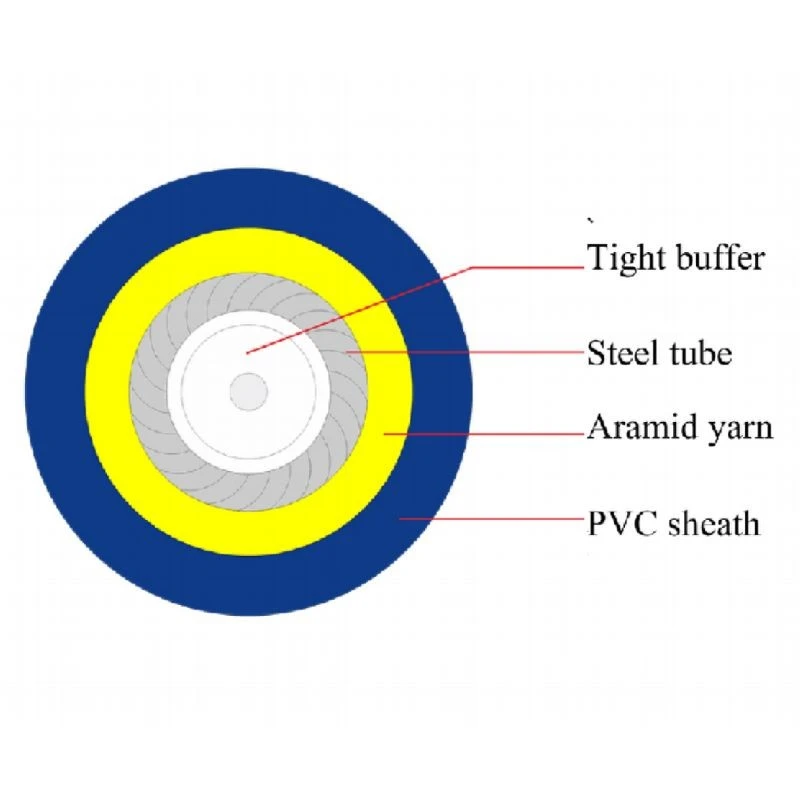
This indoor outdoor fiber optic cable consist of tight buffer with optical fibers, 1.0mm or 1.2mm steel wire as the messenger, formed like “Figure 8”. After aramid yarn is applied over the inner sheath, the cable is completed with a PE or LSZH outer sheath.
Description
Technical Parameters
our company
Features
The indoor outdoor fiber optic cable adopts a tight buffer fiber optic design. Compared with the commonly used loose tube filled grease structure for outdoor optical cables, the tight fitting structure is a dry design that does not require grease and is more in line with indoor fire safety requirements.
Environmental Characteristics
- Transport/storage temperature: -20℃ to +60℃
Delivery Length
- Standard reel length: 1km ; other lengths are also available.
Factory or trading company?
We are a manufacturer in Hangzhou City, Zhejiang province since year 1992, have 30 years' experience in coaxial cable and fiber optic cable, also have our own trading company.
own brand




Pack and ship


Tips
What is Indoor Armored Optical Cable?
Indoor armored optical cable is a special type of optical cable that features an additional metal protective layer ("armor") surrounding the optical fiber core. Its design purpose is to retain the high-bandwidth advantages of optical fiber while endowing it with the ruggedness and durability of electrical wire. It is specifically intended to solve the problem of ordinary optical cables being "delicate" and easily damaged in complex indoor environments.
Core Application Scenarios
1. Building and Vertical Riser Cabling Systems
- **Scenario:** Vertical and horizontal laying along walls, ceilings, or weak current shafts within buildings such as office buildings, hotels, and hospitals.
- **Value:** Ordinary optical cables are prone to breaking due to pulling when threading through conduits or passing through ceiling access panels. Armored optical cable has high tensile strength, can withstand tension during installation, and ensures the long-term stability of backbone lines.
2. Fiber to the Desktop (FTTD)
- **Scenario:** Introducing optical fiber directly from the distribution frame to the end user's desktop equipment.
- **Value:** In desktop environments, personnel move around frequently, objects (such as chair casters) can easily roll over cables, and cables are prone to dust contamination. Armored patch cords have high crush resistance and dustproof characteristics, allowing them to be used as robustly as copper cables. They are an ideal choice for implementing all-optical networks to the desktop.
3. Data Center and Equipment Room Interconnection
- **Scenario:** Connections between server cabinets, deployment of Storage Area Networks (SAN), and patch cords between high-density distribution frames.
- **Value:** Under data center floors, there are often rodents or airflow from ventilation, and cables are complex and tangled. The metal layer of armored optical cable prevents rodent bites, and it features a very small bend radius (20D dynamic, 10D static), facilitating cable management in tight spaces.
4. Industrial and Special Environments
- **Scenario:** Equipment rooms along subways, railways, highways, as well as control rooms and temperature monitoring system projects in power systems.
- **Value:** These environments often have risks of vibration, electromagnetic interference, or mechanical shock. The armor layer provides excellent torsion resistance and crush resistance, ensuring signal stability in harsh industrial environments.
Core Advantages and Structure
The reason indoor armored optical cable is capable of performing well in the above scenarios is primarily due to its unique "sandwich" structure. According to technical data from Baidu Baike and various manufacturers, its typical structure includes the following key components:
- **Optical Fiber and Aramid Yarn:** The innermost layer is the optical fiber, surrounded by aramid yarn (Kevlar), which provides basic tensile strength.
- **Stainless Steel Tube (Micro-armor / Single Armor):** The middle layer is a spiral "micro-armor." This is the core for crush resistance and rodent bite protection. When the cable is stepped on or bitten by rodents, this layer protects the optical fiber from damage.
- **Stainless Steel Braid (Double Armor):** An additional layer of stainless steel braided wire outside the micro-armor. This layer primarily enhances **torsion resistance**, preventing the cable from being twisted and broken.
- **Flame-Retardant Sheath:** The outermost layer typically uses **Low Smoke Zero Halogen (LSZH)** or flame-retardant PVC material. This effectively suppresses smoke diffusion in the event of a fire, ensuring personnel safety and complying with indoor fire safety standards.
Summary
In summary, indoor armored optical cable is a special type of optical cable with high mechanical strength and a high flame-retardant rating. Without sacrificing optical fiber transmission performance, it effectively solves the drawbacks of optical fiber being easily broken, susceptible to rodent bites, and vulnerable to crushing. Whether in complex building cabling or high-density data centers, choosing armored optical cable can significantly reduce later operation and maintenance costs and improve overall network reliability.
Hot Tags: indoor armored fiber optic cable, China indoor armored fiber optic cable manufacturers, suppliers, factory, Indoor Armored Fiber Optic Cable, indoor optical fiber cable, Indoor Outdoor Fiber Optic Cable
Technical Characteristics
| Fiber Count | 1~4 |
| Fiber type | G657A1 or G657A2 |
| Tight buffer Diameters | 0.6 / 0.9mm |
| Tight buffer Material | PVC |
| Dielectric Strength Member Material | Polyester yarn |
| Dielectric Strength Member size | 6*1000 Tex |
| Messenger | 1.2mm single steel wire |
| Nominal Outer Dimensions | 4.6x7.6 mm (±0.3) |
| Outer Jacket Material | LSZH |
|
Tension Strength (Short-Term / Long-Term) |
600N/300N |
|
Crush Resistance (Short-Term / Long-Term) |
2200 N/100mm 1000 N/100mm |
| Minimum Bend Radius (Static / Dynamic) | 10 x OD / 20 x OD |
*All above the cable size can be customized.
Previous
Mini Figure 8 CableSend Inquiry


