

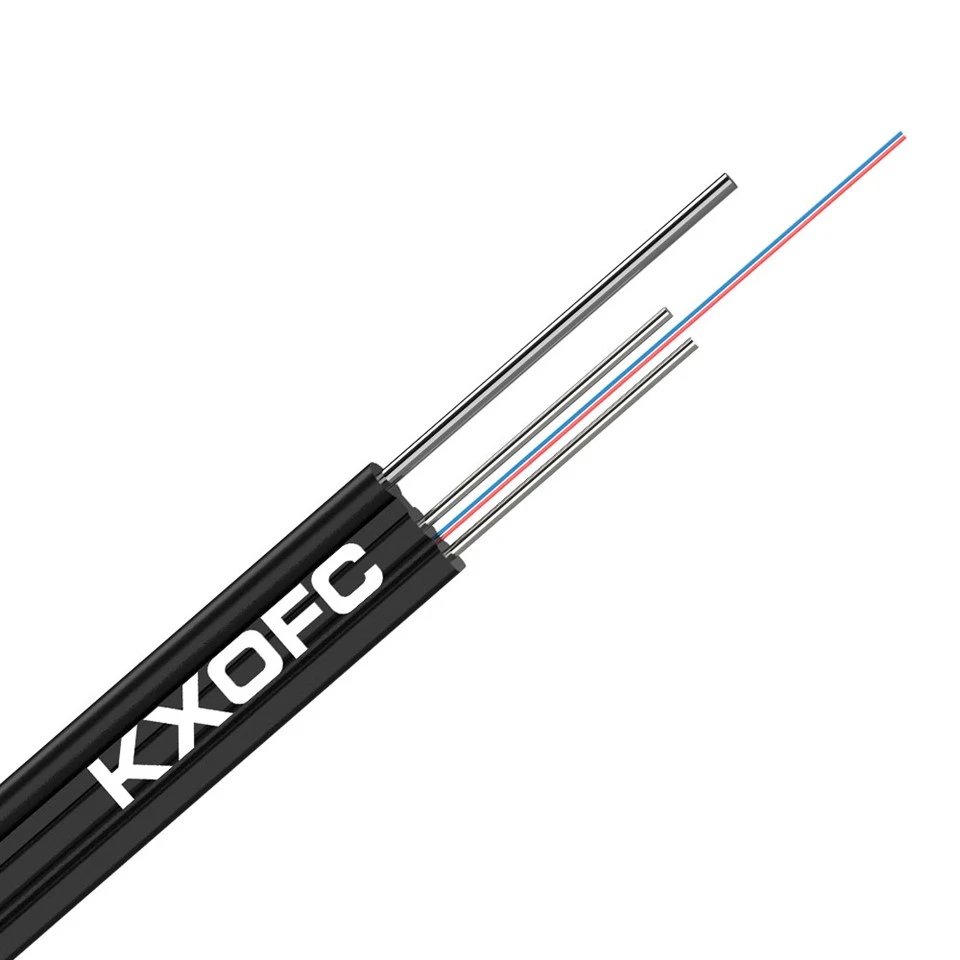
Fiber Optic Drop Cable
GJYXCH 1/2/4 core drop cable, The butterfly-shaped indoor optical cable for self-supporting access network is to place the optical communication unit in the center, place two parallel metal strengthening elements steel wire on both sides, and add a steel wire strengthening element on the outside. Finally, Extruded black or colored low-smoke halogen-free sheath into cables.
Description
Technical Parameters
our company
Features
- Simple structure and light weight.
- Good strip ability for easy splice and installation.
- LSZH sheath ensures the flame retardant performance.
- Suitable for FTTH self-supporting installation.
Environmental Characteristics
• Transport/storage temperature: -20℃ to +60℃
Delivery Length
• Standard reel length: 1km or 2km; other lengths are also available.
Standard order payment
- Payment term: T/T, L/C, D/P...
- For small orders: credit cards, Western Union money transfer and PayPal are all accepted.
- For other complex payment methods, further discussion is possible.
own brand




Pack and ship


Tips
11. What is the backscattering method?
Answer: The backscattering method is a method for measuring attenuation along the length of the fiber. The majority of the optical power in the fiber propagates in the forward direction, but a small portion is backscattered from the light source. By observing the time curve of backscattering at the light source using a splitter, one can measure the length and attenuation of the uniformly connected fiber at one end, as well as detect local irregularities, breaks, and optical power loss caused by connectors and joints.
OTDR precisely uses backscattering to measure the loss, length, etc. of the optical cable line.
12. What is the testing principle of the optical time domain reflectometer (OTDR)? What are its functions?
Answer: OTDR is based on the backscattering and Fresnel reflection principles of light. It uses the backscattered light generated during the propagation of light in the fiber to obtain information on attenuation, and can be used to measure fiber attenuation, joint loss, location of fiber faults, and understand the loss distribution along the length of the fiber. It is an indispensable tool in optical cable construction, maintenance, and monitoring. Its main indicator parameters include: dynamic range, sensitivity, resolution, measurement time, and blind zone.
13. What is the blind zone of OTDR? What impact does it have on the test? How is the blind zone handled in actual testing?
Answer: Generally, the "blind spots" caused by reflections from characteristic points such as active connectors and mechanical joints, which cause saturation at the receiving end of the OTDR, are called blind zones.
The blind zones in the fiber are divided into two types: event blind zones and attenuation blind zones. The event blind zone is the length distance from the starting point of the reflection peak to the peak of saturation at the receiver, which is caused by the reflection peak from the active connector and is called the event blind zone; Reflection peaks caused by the insertion of active connectors in optical fibers are the distances between the starting point of the reflection peaks and the points where other events can be identified. These distances are called attenuation blind zones.
For OTDR, the smaller the blind zone, the better. The blind zone increases with the increase in the width of the pulse. Increasing the pulse width not only increases the measurement length but also increases the measurement blind zone. Therefore, when testing optical fibers, narrow pulses should be used for the measurement of the fiber and adjacent event points, while wide pulses should be used for the measurement of the far end of the fiber. 14. Can OTDR measure different types of optical fibers?
Answer: If a single-mode OTDR module is used to measure multimode fibers, or a multimode OTDR module is used to measure a single-mode fiber with a core diameter of 62.5mm, the measurement results of the fiber length will not be affected, but the results of fiber loss, optical connector loss, and echo loss are incorrect. Therefore, when measuring optical fibers, it is necessary to select an OTDR that matches the tested fiber to obtain correct results for all performance indicators. 15. What do "1310nm" or "1550nm" in common optical testing instruments refer to?
Answer: It refers to the wavelength of the optical signal. The wavelength used in optical fiber communication is in the near-infrared range, between 800nm and 1700nm. It is usually divided into short-wavelength and long-wavelength bands, the former refers to the 850nm wavelength, and the latter refers to 1310nm and 1550nm. 16. In current commercial optical fibers, which wavelength of light has the minimum dispersion? Which wavelength of light has the minimum loss?
Answer: 1310nm wavelength light has the minimum dispersion, and 1550nm wavelength light has the minimum loss. 17. How are optical fibers classified based on the change in the refractive index of the fiber core?
Answer: They can be classified as step-index fibers and graded-index fibers. Step-index fibers have a narrower bandwidth and are suitable for small-capacity short-distance communication; graded-index fibers have a wider bandwidth and are suitable for medium and large-capacity communication. 18. How are optical fibers classified based on the different modes of the transmitted light waves?
Answer: They can be classified as single-mode fibers and multi-mode fibers. Single-mode fibers have a core diameter of approximately 1 to 10 μm and only transmit a single fundamental mode at a given working wavelength, suitable for large-capacity long-distance communication systems. Multi-mode fibers can transmit multiple modes of light waves and have a core diameter of approximately 50 to 60 μm, with poorer transmission performance than single-mode fibers.
When transmitting multiplexed protection current differential protection, multi-mode fibers are more commonly used between the optical-to-electrical conversion device installed in the communication room of the substation and the protection device installed in the main control room. 19. What is the significance of the numerical aperture (NA) of step-index fibers?
Answer: The numerical aperture (NA) represents the light collection ability of the fiber. The larger the NA, the stronger the light collection ability of the fiber.
20. What is the double refraction of single-mode fibers?
Answer: There are two orthogonal polarization modes in single-mode fibers. When the fiber is not perfectly cylindrical symmetric, the two orthogonal polarization modes are not degenerate. The absolute value of the difference in refractive indices of the two orthogonal polarization modes is the double refraction.
Hot Tags: fiber optic drop cable, China fiber optic drop cable manufacturers, suppliers, factory, Aerial Drop Cable, duplex patch cord, Flat Drop Fiber Cable, ftth drop cable and patch cords, FTTH GJYXCH cable, Outdoor Drop Cable
Technical Characteristics
|
No. of cable |
1/2/4 |
|||
|
Fiber Model |
G.657A1 |
|||
|
Strength Member |
Material |
Steel Wire |
||
|
Diameter(±0.03)mm |
0.4 |
|||
|
NO. |
2 |
|||
|
Support member |
Material |
Steel Wires |
||
|
Diameter(±0.03)mm |
7*0.33 |
|||
|
Outer Sheath |
Material |
LSZH |
||
|
Colour |
Black / white |
|||
|
Cable Diameter(±0.2)mm |
2.0×5.0 |
|||
|
Cable Wetght(±2)kg/km |
20 |
|||
|
Attenuation |
1310nm |
dB/km |
0.40 |
|
|
1550nm |
0.30 |
|||
|
Allowable Tensile Strength |
Short Term |
N |
600 |
|
|
Long Term |
300 |
|||
|
Allowable Crush Resistance |
Short Term |
N/100mm |
2200 |
|
|
Long Term |
1000 |
|||
|
Min. bending radius |
Without Tension |
15.0×Cable-φ |
||
|
Under Maximum Tension |
30.0×Cable-φ |
|||
|
Temperature range (℃) |
Installation |
-20~+60 |
||
|
Transport&Storage |
-40~+60 |
|||
|
Operation |
-40~+60 |
|||
*All above the cable size can be customized.
Previous
Fiber Optic Cable 2 CoreNext
GjyxchSend Inquiry
You Might Also Like


