

Outdoor Fiber
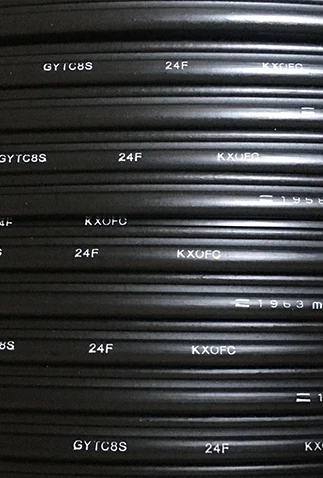
GYTC8Y outdoor fiber, fiber in the loose tubes which are filled with waterproof compound. The non-armored design enhances flexibility, while the figure-8 structure is suitable for overhead installation. It can efficiently connect different communication nodes and provide support for trunk and regional communication network.
Description
Technical Parameters
Products Description
our compa
Features
Self supporting aerial fiber cable has reasonable design and accurate control of the residual length of the fiber in the loose tube, so that self supporting aerial fiber cable has excellent tensile performance and temperature performance. The cable core is filled with oil paste to ensure longitudinal water resistance. A single polyethylene jacket with additives offers superior protection against UV radiation, fungus, abrasion, and other environmental factors.
Environmental Characteristics
• Transport/storage temperature: -40℃ to +60℃
Delivery Length
• Standard reel length: 2km/drum; other lengths are also available.
Can I customize fiber optic cable specifications?
Yes, we provide full customization service for optical cables. We can customize fiber core number (1/4/8/12/24/48/96/144 cores), fiber type (G652D/G657A1/G657A2), cable length, jacket color, sheath material and tensile strength according to your project requirements.
own brand




Pack and ship


Tips
Applications of AI in Cable Manufacturing:
1. Quality Control Challenges in Optical Cable Manufacturing
The manufacturing process of optical cables is far more complex than people imagine. An optical cable typically contains multiple layers, including multiple optical fibers, reinforcing components, filler ropes, water-blocking materials, armor layers, and an outer sheath, each requiring precision machining. The production process encompasses multiple steps such as fiber coloring, plastic coating, cabling, armoring, and sheath extrusion. Deviations in any step can affect the final performance of outdoor fiber.
In traditional manufacturing models, quality control mainly relies on the following methods: operators periodically inspect the production line; quality inspectors perform sampling inspections after finished products come off the line; and equipment maintenance is performed on a fixed schedule, regardless of whether the equipment actually needs maintenance. This approach has significant shortcomings: manual inspections cannot achieve full-time, full-scale inspection; sampling inspections have the risk of missed inspections; and fixed-cycle maintenance may lead to waste due to "not repairing when it should and stopping production when it shouldn't."
2. AI Visual Inspection Improves Quality Consistency
Computer vision is one of the most mature areas of AI technology application in cable manufacturing. Deep learning-based image recognition systems can be deployed at multiple key nodes on the production line for continuous, automated inspection of product appearance.
In the fiber coloring process, the coloring layer needs to be uniformly coated on the fiber surface. Color not only identifies different fibers but also directly affects the splicing efficiency of subsequent optical cables. AI vision systems can monitor the uniformity, color accuracy, and presence of defects in the coloring layer in real time. Upon detecting an anomaly, the system immediately issues an alarm, allowing operators to adjust process parameters promptly and prevent batch defects.
In the sheath extrusion process, the outer sheath of the optical cable needs to ensure roundness, uniform thickness, and a smooth surface. Traditional inspection methods involve quality inspectors measuring the outer diameter with calipers and visually inspecting the surface quality. This method is inefficient and prone to missing periodically occurring micro-defects. AI vision systems, combined with high-speed industrial cameras, can detect micron-level surface defects even when the optical cable passes through the inspection point at speeds of hundreds of meters per minute. Defects such as bubbles, scratches, dents, and impurities can be automatically identified and marked, with inspection speed and accuracy far exceeding manual methods.
3. Intelligent Process Optimization and Predictive Maintenance
Beyond visual inspection, AI technology also plays a role in process optimization and equipment maintenance. Fiber optic drawing is one of the most critical processes in optical cable manufacturing. During drawing, the fiber preform is heated to approximately 2000 degrees Celsius and drawn into a fine filament with a diameter of 125 micrometers at a precisely controlled speed. The interrelationships between parameters such as drawing speed, furnace temperature, and tension are extremely complex; even slight fluctuations can affect the geometric accuracy and optical performance of the fiber. Using machine learning algorithms, historical production data can be mined to establish a quantitative model between process parameters and product quality. Thus, when raw material batches or environmental conditions change, the system can automatically recommend the optimal combination of process parameters, reducing reliance on operator experience.
Predictive maintenance is another area of significant value. Outdoor fiber,Unplanned downtime of critical equipment on the production line, such as drawing towers and extruders, can result in substantial economic losses. By continuously analyzing operational data such as equipment vibration, temperature, and current, AI systems can identify abnormal trends in equipment status in advance, issuing warnings days or even weeks before a failure occurs. Maintenance personnel can make reasonable maintenance plans based on the early warning information to avoid emergency shutdowns and reactive maintenance.
Hot Tags: outdoor fiber, China outdoor fiber manufacturers, suppliers, factory, Aerial Fiber Optic Cable, Fiber Optic Overhead Cable, Outdoor Aerial Fiber Optic Cable, Overhead Fiber Optic Cable, Self Supporting Aerial Fiber Cable, Self Supporting Fiber Optic Cable
Technical Characteristics
|
Fiber Count |
4~96 |
|
Loose Diameters |
2.2 mm |
|
Loose Material |
PBT ((Polybutylene Terephthalate)) |
|
Self Strength Messenger |
Steel wire |
|
Central Strength Member |
Steel wire |
|
Outer Jacket Material |
HDPE |
|
Messenger |
7*1.2mm steel wires |
|
Nominal Outer Dimension |
9.0mm*14mm (±0.3) |
|
Tension Strength (Long-Term /Short-Term) |
3000N/7000N |
|
Crush Resistance (Long-Term /Short-Term) |
300 N/1000mm |
|
Minimum Bend Radius (Static / Dynamic) |
10 x OD / 20 x OD |
*All above the cable size can be customized.
Previous
Fiber LinkNext
outdoor fiber cableSend Inquiry


